Marie Curie : une femme qui a changé la science
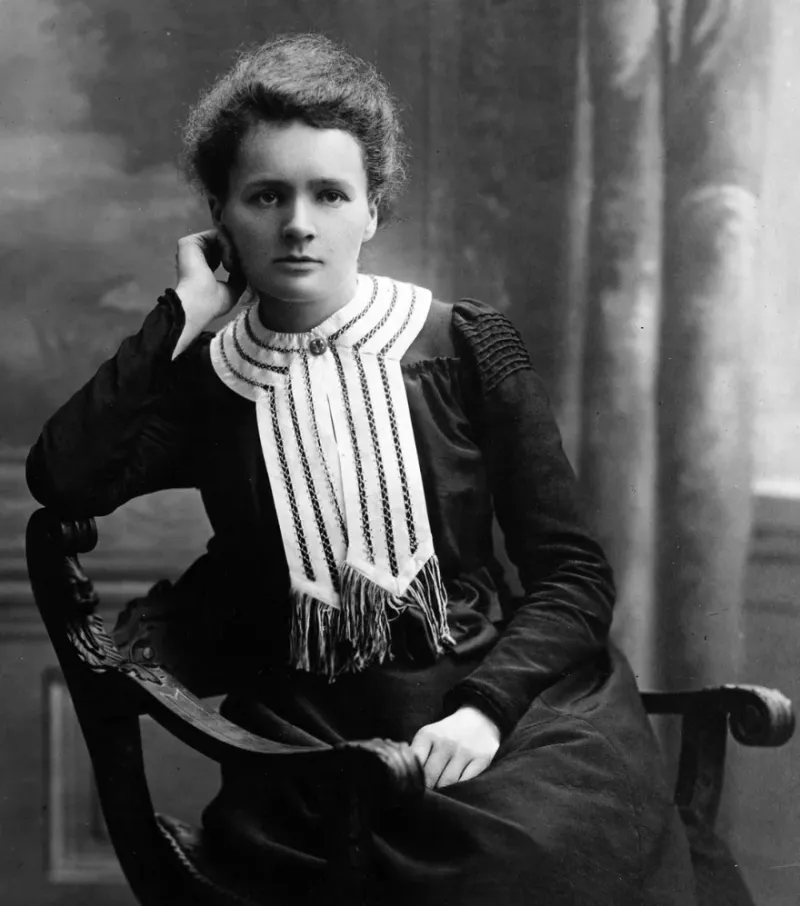
Marie Curie, née Maria Salomea Skłodowska le 7 novembre 1867 à Varsovie, n’était pas seulement une scientifique hors du commun : elle était une révolution à elle seule. Fille d’un professeur de sciences et d’une institutrice, elle grandit dans une Pologne encore sous domination russe, où parler polonais et rêver d’université était déjà un acte de résistance.
La petite Maria, brillante élève, découvre très tôt la saveur du savoir… Et celle de l’injustice : les femmes n’ont pas le droit d’étudier à l’université. Elle rejoint une « université volante », un réseau clandestin d’enseignement tenu par des intellectuels polonais, où elle apprend la physique, la chimie et les mathématiques en cachette.
De Varsovie à Paris
Mais Varsovie devient trop étroite pour son ambition, à 24 ans, elle prend un billet pour Paris, un aller simple vers la liberté. À la Sorbonne, elle découvre un monde de connaissances et aussi la faim, le froid, la solitude. On raconte qu’elle étudiait emmitouflée dans un manteau, mangeant à peine, mais que rien n’entamait sa concentration. En 1893, elle obtient sa licence de physique, puis l’année suivante celle de mathématiques, major de sa promotion.
Pierre Curie, une rencontre décisive
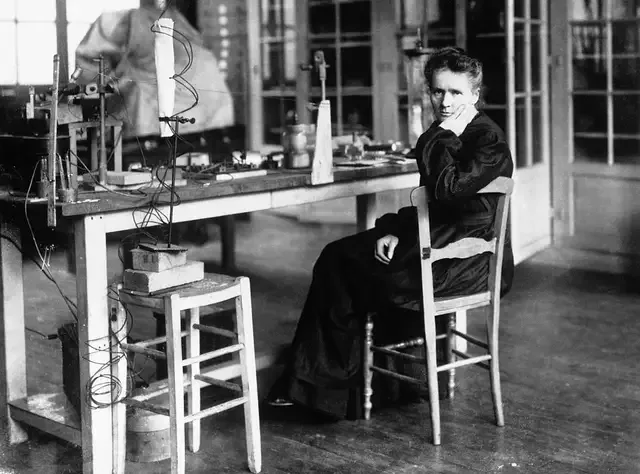
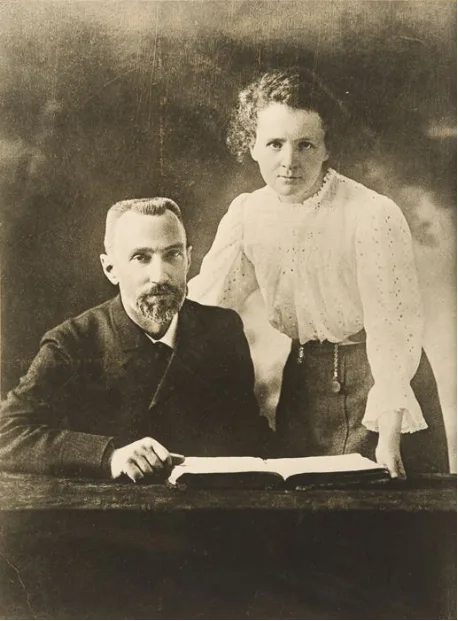
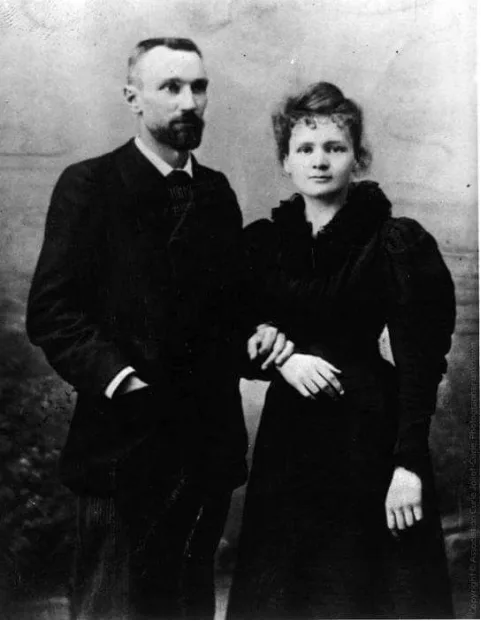
Cette jeune femme inflexible croise alors la route d’un autre esprit passionné, Pierre Curie. Leur rencontre, en 1894, tient du coup de foudre intellectuel : deux âmes unies par l’amour des expériences et des formules. Ensemble, ils se marient un an plus tard, dans une cérémonie simple. Le couple partage tout : le travail, la curiosité, la rigueur… Et bientôt la gloire scientifique.
La découverte du polonium et du radium
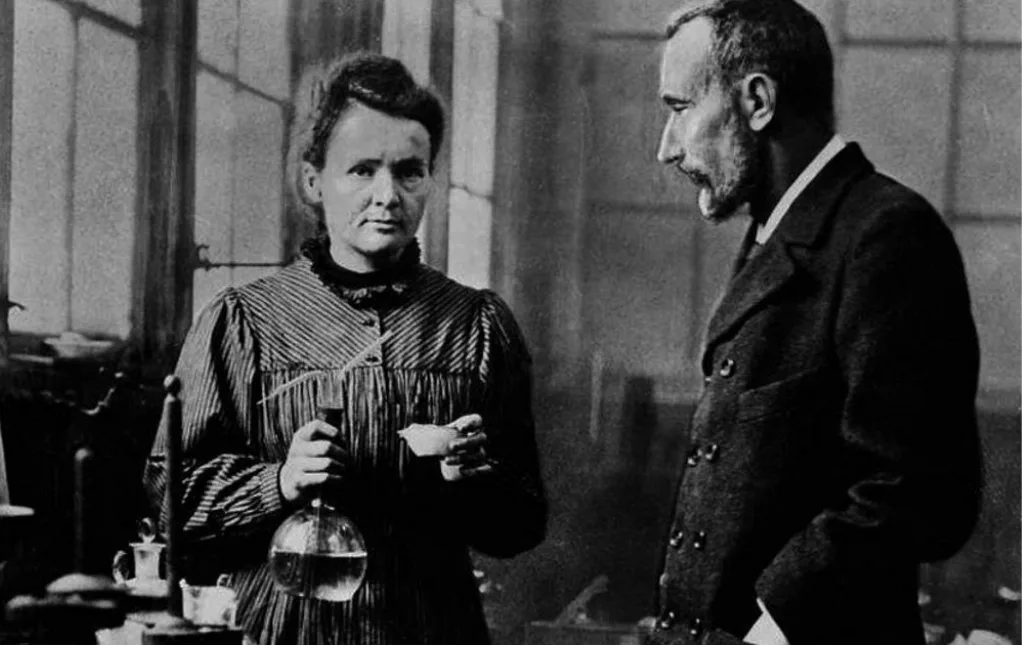
En 1898, après des mois de recherches éreintantes dans un hangar glacial transformé en laboratoire, ils découvrent deux nouveaux éléments : le polonium, en hommage à la Pologne, et le radium, dont la mystérieuse lueur bleutée fascine autant qu’elle effraie. Ce travail, réalisé dans des conditions inimaginables (leurs carnets de laboratoire sont encore radioactifs aujourd’hui), leur vaut le Prix Nobel de Physique en 1903, partagé avec Henri Becquerel.
Marie devient alors la première femme nobélisée, un exploit qui secoue un monde scientifique encore très masculin. Mais le destin, cruel, frappe en 1906 : Pierre meurt tragiquement, renversé par une voiture à cheval dans les rues de Paris. Veuve à 38 ans, mère de deux filles, Marie pourrait tout abandonner. Au contraire, elle relève la tête, reprend le poste de son mari à la Sorbonne, devenant la première femme professeure de l’université et poursuit seule leurs travaux. En 1911, elle remporte un second Prix Nobel, cette fois en Chimie, pour avoir isolé le radium pur et approfondi la compréhension de la radioactivité. Aucun autre être humain, avant ou depuis, n’a reçu deux Prix Nobel dans deux disciplines scientifiques différentes.
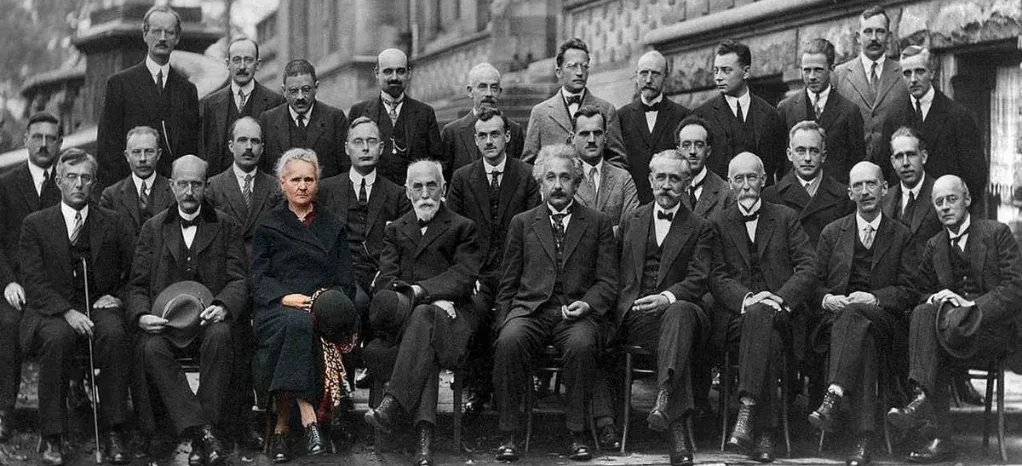
Lors de ce fameux Congrès Solvay de 1927, Marie Curie n’est pas une simple figure, elle est l’ancrage de la science expérimentale face à l’abstraction naissante. La seule femme parmi les vingt-neuf savants réunis à l’hôtel Métropole de Bruxelles, elle siège au premier rang, juste à côté d’Einstein et de Lorentz, incarnant une autorité morale et scientifique que nul ne conteste. Sa présence ce jour-là n’est pas seulement un symbole de réussite exceptionnelle dans un bastion masculin, c’est le lien vital entre la physique des pionniers et la révolution quantique qui s’opère sous ses yeux, prouvant que sans ses découvertes fondamentales sur l’atome, aucun des débats théoriques de ce congrès n’aurait pu voir le jour.
La science au service des autres
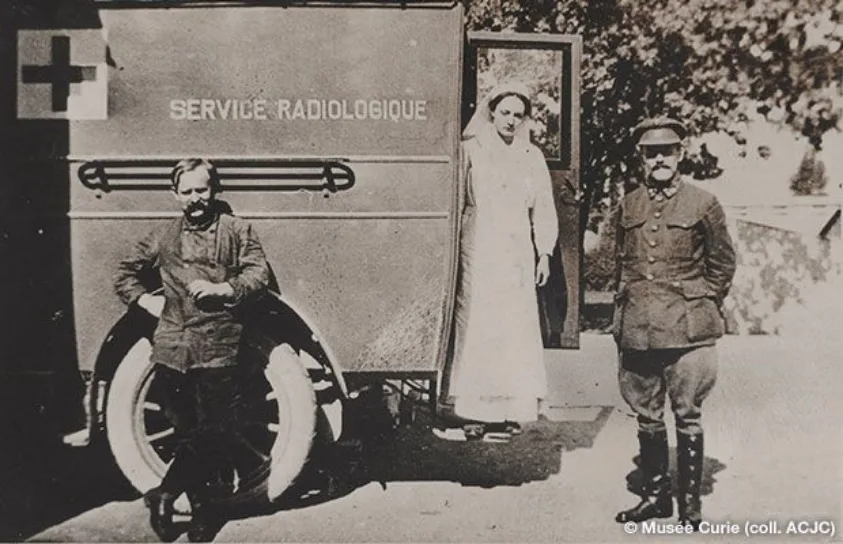
Mais Marie Curie n’était pas qu’une chercheuse de laboratoire, elle était aussi une femme de terrain, une pionnière engagée. Pendant la Première Guerre mondiale, elle comprend que la radiologie pourrait sauver des vies sur le front. Avec sa fille aînée Irène, elle équipe des ambulances de petits appareils à rayons X, les fameuses « Petites Curies » qu’elle conduit elle-même jusqu’aux zones de combat. Elle forme des infirmières et des médecins à s’en servir, parfois en plein champ de bataille, au risque de sa propre vie. On estime qu’elle permit de soigner plus d’un million de soldats blessés.
Ce que peu de gens savent, c’est qu’elle transportait elle-même des fioles de radium dans sa poche, sans aucune protection, inconsciente du danger. Et pourtant, c’est cette ignorance qui la tuera lentement. Pendant des décennies, elle manipule des substances hautement radioactives sans gants ni masque, fascinée par cette énergie invisible qu’elle croyait porteuse d’avenir. Elle tombe malade, affaiblie, mais continue à travailler sans relâche, jusqu’à sa mort, le 4 juillet 1934, d’une anémie aplasique causée par une trop forte exposition aux radiations. Ironie du sort : la lumière qui l’a guidée toute sa vie finira par l’user de l’intérieur.
Un héritage toujours vivant
Son héritage, lui, ne s’est jamais éteint. En 1995, Marie Curie entre au Panthéon, première femme à y reposer pour ses propres mérites, aux côtés de Pierre. Sa dépouille, encore radioactive, a été placée dans un cercueil doublé de plomb. Sa fille Irène et son gendre Frédéric Joliot-Curie, eux aussi prix Nobel de Chimie, perpétuent la lignée des savants Curie, formant la plus illustre dynastie scientifique de l’histoire. L’Institut du Radium qu’elle avait fondé à Paris devient l’actuel Institut Curie, un centre de recherche et de soins mondialement reconnu dans la lutte contre le cancer.
Le radium qu’elle a isolé, autrefois source de fascination et de danger, a ouvert la voie à la radiothérapie moderne. Et pour l’anecdote, l’élément chimique Curium, découvert en 1944, porte son nom et celui de Pierre. Mais ce que l’on retient avant tout de Marie Curie, c’est sa force tranquille, son humilité et son humanité. Elle refusait de breveter ses découvertes, estimant que la science devait appartenir à tous. Elle croyait à l’éducation comme moteur d’émancipation, à la curiosité comme valeur universelle. Elle n’a jamais cherché la gloire, seulement la vérité.
« Rien dans la vie n’est à craindre, tout est à comprendre. », disait-elle. Cette phrase, à elle seule, résume le fil rouge de son existence.
Marie Curie, born Maria Salomea Skłodowska on 7 November 1867 in Warsaw, was not just an extraordinary scientist : she was a revolution in her own right. The daughter of a science teacher and a primary school teacher, she grew up in a Poland still under Russian rule, where speaking Polish and dreaming of university was already an act of resistance. Little Maria, a brilliant pupil, discovered the joy of learning at a very early age… and the bitterness of injustice : women were not allowed to study at university. She joined a ‘flying university’, a clandestine educational network run by Polish intellectuals, where she studied physics, chemistry and mathematics in secret.
But Warsaw became too confining for her ambitions ; at the age of 24, she bought a ticket to Paris – a one-way ticket to freedom. At the Sorbonne, she discovered a world of knowledge, but also hunger, cold and loneliness. It is said that she studied wrapped up in a coat, barely eating, yet nothing could shake her concentration. In 1893, she obtained her bachelor’s degree in physics, followed the next year by one in mathematics, graduating at the top of her class.
This unyielding young woman then crossed paths with another passionate mind, Pierre Curie. Their meeting, in 1894, was a case of intellectual love at first sight : two souls united by a love of experiments and equations. They married a year later, in a simple ceremony. The couple shared everything : their work, their curiosity, their rigour… and soon, scientific fame. In 1898, after months of gruelling research in a freezing shed converted into a laboratory, they discovered two new elements : polonium, named in honour of Poland, and radium, whose mysterious bluish glow was as fascinating as it was frightening. This work, carried out under unimaginable conditions (their laboratory notebooks are still radioactive today), earned them the Nobel Prize in Physics in 1903, shared with Henri Becquerel.
Marie thus became the first woman to be awarded a Nobel Prize, a feat that shook the scientific world, which was still very much a male-dominated field. But fate dealt a cruel blow in 1906 : Pierre died tragically, struck down by a horse-drawn carriage on the streets of Paris. A widow at the age of 38 and mother of two daughters, Marie could have given up everything. On the contrary, she held her head high, took over her husband’s post at the Sorbonne – becoming the university’s first female professor – and continued their work alone. In 1911, she won a second Nobel Prize, this time in Chemistry, for isolating pure radium and deepening our understanding of radioactivity. No other human being, before or since, has received two Nobel Prizes in two different scientific disciplines.
At that famous Solvay Conference of 1927, Marie Curie was not merely a figurehead ; she was the bedrock of experimental science in the face of emerging abstraction. The only woman amongst the twenty-nine scientists gathered at the Hôtel Métropole in Brussels, she sat in the front row, right next to Einstein and Lorentz, embodying a moral and scientific authority that no one disputed. Her presence that day was not merely a symbol of exceptional achievement in a male-dominated field ; it was the vital link between the physics of the pioneers and the quantum revolution unfolding before her very eyes, proving that without her fundamental discoveries on the atom, none of the theoretical debates at that congress could ever have taken place.
But Marie Curie was not just a laboratory researcher ; she was also a woman of action, a committed pioneer. During the First World War, she realised that radiology could save lives on the front line. Together with her eldest daughter, Irène, she equipped ambulances with small X-ray machines – the famous ‘Petites Curies’ – which she drove herself to the combat zones. She trained nurses and doctors to use them, sometimes right on the battlefield, at the risk of her own life. It is estimated that she helped treat over a million wounded soldiers.
What few people know is that she carried vials of radium in her pocket herself, without any protection, unaware of the danger. And yet, it was this ignorance that would slowly kill her. For decades, she handled highly radioactive substances without gloves or a mask, fascinated by this invisible energy which she believed held the key to the future. She fell ill and grew weak, but continued to work tirelessly until her death on 4 July 1934 from aplastic anaemia caused by excessive exposure to radiation. In an ironic twist of fate, the light that had guided her throughout her life would ultimately consume her from within.
Her legacy, however, has never faded. In 1995, Marie Curie was interred in the Panthéon, the first woman to be laid to rest there on her own merits, alongside Pierre. Her remains, which were still radioactive, were placed in a lead-lined coffin. Her daughter Irène and her son-in-law Frédéric Joliot-Curie, both Nobel laureates in Chemistry, carried on the Curie family’s scientific legacy, forming the most illustrious scientific dynasty in history. The Radium Institute she had founded in Paris became the present-day Curie Institute, a world-renowned centre for research and treatment in the fight against cancer.
The radium she isolated – once a source of both fascination and danger – paved the way for modern radiotherapy. And, as an interesting aside, the chemical element curium, discovered in 1944, is named after her and Pierre. But what we remember most of all about Marie Curie is her quiet strength, her humility and her humanity. She refused to patent her discoveries, believing that science should belong to everyone. She believed in education as a driving force for emancipation, and in curiosity as a universal value. She never sought glory, only the truth.
« There is nothing in life to fear ; everything is there to be understood. » She used to say. That sentence alone sums up the central theme of her life.
Commentaires (1)
Superbe article !
Se connecter pour commenter